Forced Embedded HDOC
There are now two kinds of Embedded HDOC: forced and non-forced.
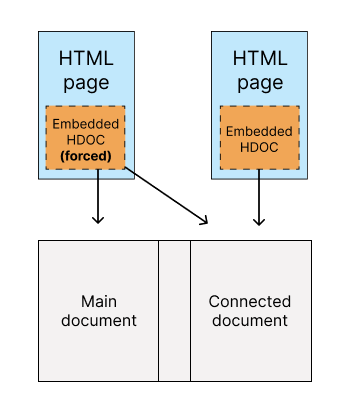
Forced Embedded HDOC
If you open a forced Embedded HDOC with the browser extension installed, you will see it rendered as an HDOC. This allows website owners to "sit on the fence" by leaving the choice of document format to the user. Users who have the extension installed will see the HDOC version, while everyone else will see the original HTML page.
Regular (non-forced) Embedded HDOC
A regular (non-forced) Embedded HDOC can be used on pages where the website owner wants the page to always be presented as an HTML page with its custom styling preserved.
Three types of web pages
There are three general types of web pages:
- a web app
- a landing page
- a blog post
Let's look at them one by one and see how Embedded HDOC can be used for each type.
Web app
A web app usually has dynamic content and interactive functionality. You generally don't want to use visible connections on such pages. These pages are outside the scope of Reader's Web, so we can ignore them.
Landing page
By "landing page," I mean any page where the author:
- want's to use custom styles
- doesn't plan to use visible connections to other pages
Such a page does not have to be a literal landing page. It can even be a blog post. What matters is that the author wants to preserve its custom styling.
You should use a non-forced Embedded HDOC on such pages. It will always display the original HTML page with its custom styles unless the page is opened as a connected document.
Blog post
Blog posts can use the forced variant of Embedded HDOC. If you have the extension installed, such posts will always be rendered as HDOCs.
Today, using my server plugin, you can serve four variants of HDOC.
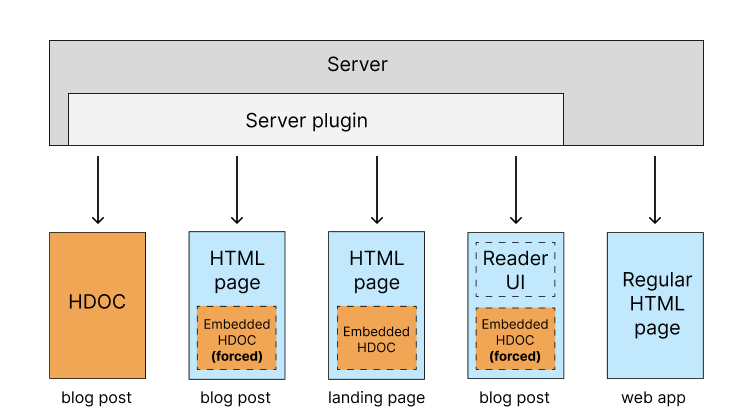
To better understand them you can read this article.
In the future, once mainstream browsers support these document formats natively, forced Embedded HDOCs will be replaced by standalone HDOCs.
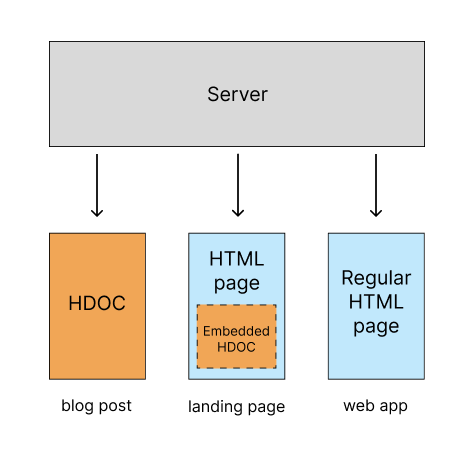
Non-forced Embedded HDOCs, however, will not become obsolete even when browsers support standalone HDOCs. There will always be some pages where authors want to preserve their custom styling.
Why would authors add Embedded HDOCs to their pages if they do not care about visible connections?
In the future, when browsers support new document formats natively, content management systems like WordPress will likely support them as well. A server plugin will no longer be needed, and Embedded HDOCs may be added to landing pages automatically without website owners having to think about them.